Dough
68%
Hydration
Wet enough to be stirred, not kneaded, and to press out to the skillet wall without fighting back. Drier than a Detroit or Sicilian dough on purpose — a small, deep pan wants a dough that holds its height.
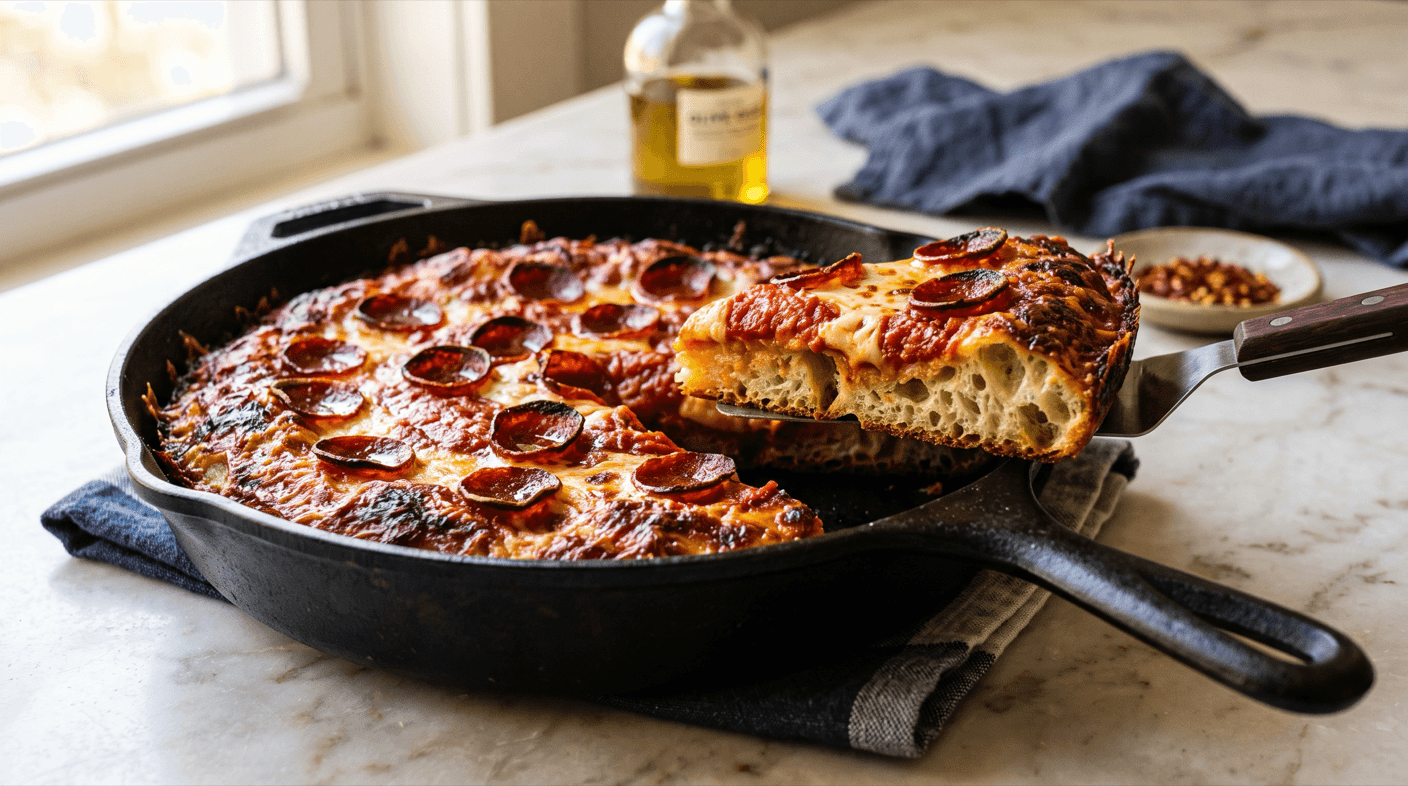
A home-kitchen workaround from the 2010s, made canonical by Kenji López-Alt's Foolproof Pan Pizza at Serious Eats. A wet, no-knead dough proofs in a heavily oiled skillet and bakes into a thick, soft pie with a fried, crackling bottom and a rim of cheese crisped against the iron. No stone, no peel; if you own one heavy pan, you can make this tonight.
Cast iron pizza is not a regional tradition so much as a home-kitchen workaround that turned out to be better than the problem it solved. A pizza stone takes an hour to heat and never gets a home oven past 550°F. A cast iron skillet holds more heat than a stone, sits on a burner as well as in the oven, and fries the dough in oil the way a Detroit pan or a Sicilian sheet does — on a smaller, rounder scale.
The version most people make traces to J. Kenji López-Alt's Foolproof Pan Pizza at Serious Eats: a no-knead dough left to rise all day, pressed into an oiled 10-inch skillet, proofed again, and baked in the hottest oven. America's Test Kitchen and a long tail of food writers followed with the same moves and their own hydration. What they share is the finish — if the bottom comes out pale, the skillet goes back onto the stove for a minute or two until it isn't.
It is a pan pizza in the American sense: thick, soft inside, with a rim of cheese fried against the iron. It is not a Neapolitan and never will be — a skillet under a broiler can blister a thin round, but the style built for the pan is this one.
A 68% hydration dough with a little oil, stirred until no dry flour remains and never kneaded. Long rise at room temperature or overnight in the fridge. Pressed into a cast iron skillet coated with 2-3 tablespoons of olive oil, proofed in the pan until puffy, cheese pushed to the wall, sauce on top. Baked at 550°F for 12-15 minutes, then crisped on a burner if the bottom needs it.
Wet enough to be stirred, not kneaded, and to press out to the skillet wall without fighting back. Drier than a Detroit or Sicilian dough on purpose — a small, deep pan wants a dough that holds its height.
Sized to the pan, not to a pie. The calculator defaults to a 10" skillet at a thin crust setting; switch to 12" for a bigger pie or to medium for a taller one.
Middle rack, hottest oven. Lift an edge with a spatula before you pull it — if the bottom is pale, set the skillet over a medium burner for a minute or three. That is the step no sheet pan can do.
Opens the dough calculator with Cast Iron Pan pre-selected. Pick your skillet size and when you want to eat; we'll handle the no-knead mix, the folds, the pan oil and the in-skillet proof.
The topping calculator opens with the Cast Iron Classic preconfigured — mozzarella to the wall, sauce on top, pepperoni.
Three questions on budget, space, and how often you bake — we'll recommend a curated equipment build to get you started.